
Nigeria’s National Security Challenges: Why Intelligence Must Drive the Next Phase of Security
· 5 min read
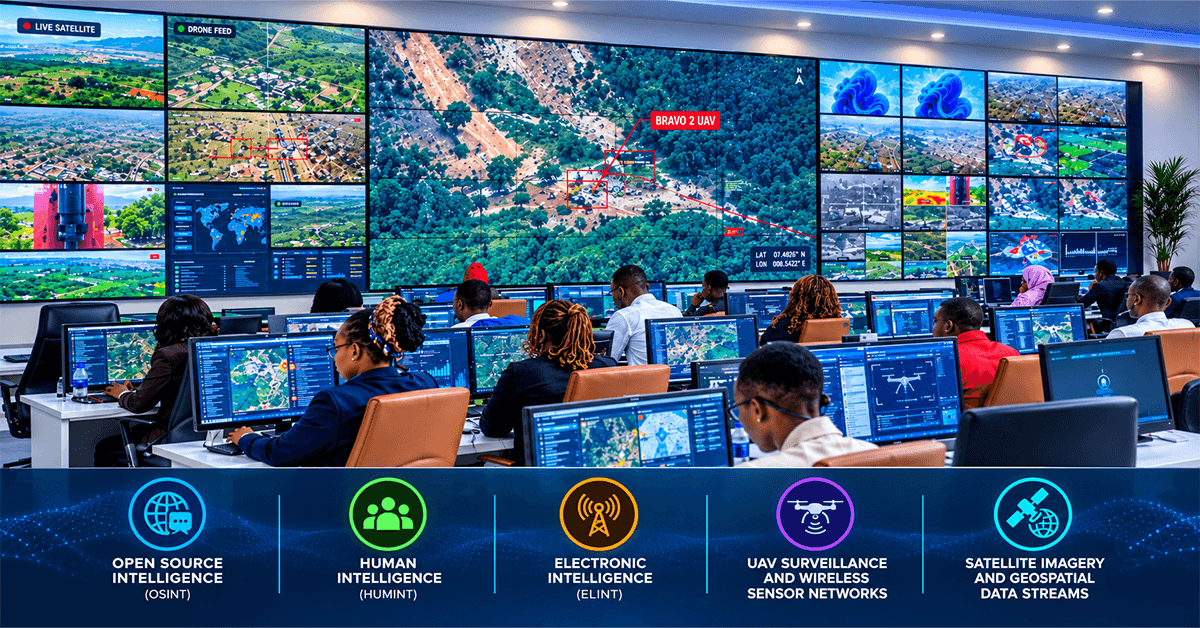
ABUJA, NIGERIA – Nigeria’s national security environment is becoming increasingly complex. Terrorism, armed banditry, kidnapping, communal violence and emerging cyber threats operate across different environments, affect diverse socio-economic sectors and demand tailored operational responses. Their consequences extend far beyond immediate threats to lives and property, disrupting rural livelihoods, stalling commercial investment, eroding public confidence, and weakening state institutions' capacity to govern securely.
The National Counter Terrorism Centre (NCTC) continuously identifies kidnapping, armed banditry and non-state militia activities among the most severe asymmetric threats confronting the nation. Concurrently, Nigeria’s accelerating dependence on digital infrastructure has expanded the operational battlespace, introducing grave national risks surrounding critical communications, enterprise data and state information networks.
This evolving threat landscape raises a fundamental strategic question that transcends physical force, troop numbers or hardware acquisitions: Do Nigeria’s security institutions possess the intelligence, technology and inter-agency coordination required to detect threats early enough to make decisive, preventative choices?
Addressing this question is vital. Effective modern security is not merely about post-incident response; it relies on identifying underlying patterns, mapping operational vulnerabilities, anticipating threat trajectories and translating raw information into tactical action.
From Conventional Threats to a Multi-Domain Security Landscape
Nigeria’s security challenges do not stem from a single source or unified adversary. Terrorist organisations, sophisticated kidnapping syndicates, heavily armed bandits, localised communal militias and cybercriminals operate in vastly different contexts, presenting distinct hazard profiles.
The North-East: Counter-insurgency operations continue to confront ideological extremist violence and the complex socio-economic fallout of prolonged conflict.
The North-West and North-Central: Organised kidnapping and banditry destabilise rural communities, threaten transit corridors, paralyse agricultural output and disrupt regional trade.
Cross-Border Dynamics: These regional challenges are further exacerbated by dense, unpoliced terrain, severe infrastructure deficits, persistent intelligence blind spots and the fluid movement of criminal networks across state and national borders.
This multifaceted complexity makes a rigid, uniform military response unsustainable. Different threat vectors require specialised forms of intelligence collection, strategic planning, targeted technological capabilities and continuous risk assessment.
For public institutions, this demands robust early-warning mechanisms and streamlined inter-agency intelligence fusion. For commercial enterprises, it necessitates rigorous risk assessments covering personnel, physical infrastructure, supply chains and operating environments before threats turn into operational disruptions. Ultimately, both public and private sectors require a clearer, real-time understanding of their operational environment.
Why Intelligence-Led Security Matters
One of the defining shifts in modern defence architecture is the transition towards intelligence-led decision-making.
Traditional security models tend to be reactive, becoming visible only after an attack or security breach has occurred. Intelligence-led security introduces a proactive doctrine: gathering, evaluating and interpreting disparate data streams to identify potential vulnerabilities before crisis points emerge.
However, the core value of intelligence lies not in the sheer volume of data collected but in synthesis. Raw information becomes actionable intelligence only when fragmented signals are analysed, correlated and mapped against a contextual understanding of risk.
Quality, legality and institutional integrity are essential to this process. Intelligence must be accurate, lawfully gathered, rigorously analysed and operationalised in service of legitimate, constitutionally backed defence goals. Advanced technology can drastically increase the speed and volume of incoming data, but data alone is not intelligence. Analysis, interpretation and strategic application give raw data its operational utility.
From Information to Action: Integrating the Security Cycle
The operational value of intelligence-led defence becomes clear when distinct security capabilities operate as a unified system across the entire incident lifecycle.
1. Strategic Intelligence & Monitoring: Early-warning reporting helps decision-makers grasp subtle shifts within volatile operating environments and identify emerging threat vectors.
2. Forensic & Digital Investigation: Post-incident forensic analysis reconstructs events, secures immutable digital evidence, maps criminal networks and supports institutional accountability.
While distinct in function, threat monitoring and forensic investigation form an interdependent cycle: understanding risk drives prevention, while forensic analysis ensures accountability. Both feed vital insights back into strategic planning.
Rather than treating intelligence gathering, visual surveillance, forensic analysis and defence software as disconnected silos, modern security mandates seamless data integration.
Within THE EIB GROUP, this integrated paradigm shapes its defence and technology subsidiaries. EIB Stratoc delivers strategic intelligence reporting, threat monitoring and geopolitical risk assessments, while Giga Forensics deploys specialised digital intelligence, signal analytics (SIGINT) and forensic capabilities. The true advantage lies not in these standalone capabilities, but in their capacity to connect specialised tools around a unified national security objective.
The Shift From Reaction to Enterprise Risk Management
For Nigeria, adopting an intelligence-led posture carries broad implications beyond frontline military operations.
Commercial enterprises operating in complex regions must evaluate geopolitical and security risks before deploying capital, building infrastructure or moving personnel. Civil government institutions require actionable data to guide infrastructure planning, civil protection and timely intervention. Security agencies require interoperable software systems that translate complex, high-volume data streams into clear situational awareness.
This aligns national security directly with broader enterprise risk management. The goal is not to predict every isolated incident or eliminate uncertainty, but to elevate the quality of intelligence available to leaders, strengthening institutional resilience in a changing world.
Achieving this standard requires more than hardware acquisition. It demands highly trained analysts, lawful intelligence protocols, robust data-governance frameworks and seamless coordination across military, civil and commercial systems.
Building the Next Phase of National Defence
Nigeria’s security environment will continue to evolve, and national defence strategy must adapt alongside it.
The next era of Nigerian security will not be defined by isolated military purchases or static deployments. Instead, it will depend on how effectively national institutions collect multi-domain data, analyse complex intelligence, coordinate joint responses and manage risk across connected physical and digital environments.
The central question is no longer whether Nigeria can acquire more security hardware. It is whether the nation is building the analytical capacity to interpret what its data reveals and the institutional resolve to convert that understanding into responsible, decisive action.
That is where intelligence-led security moves from a theoretical concept to a national imperative: providing the blueprint to shift from reaction to readiness, from fragmented information to clarity, and from isolated capabilities to unified security leadership.
 eibgroup.comEIB Group - Tech Innovation & Defense SolutionsPioneering cutting-edge technology and defense solutions across AfricaVisit EIB Group